


The compounds described below are mostly compounded preparations dispensed on a prescription or research compounds that are not FDA-approved finished products, and any prescription medication requires a licensed clinician. Every clinical claim links to a primary source. Last reviewed June 2026.
Here’s my unfashionable position: if a peptide makes you wait months before the headline number shows up, that’s the compound telling you the truth. Everyone treats “it takes forever to work” as a complaint. I read it as a receipt.
I’ve spent enough time in the data to notice a pattern nobody markets, because it doesn’t sell anything. The compounds with real trials behind them are, almost without exception, the slow ones. The compounds people claim work fast are, almost without exception, the ones nobody has actually measured. That correlation is not a coincidence, and I think it flips the usual “when will I feel something” question on its head.
The case for slow
Look at what the big numbers actually cost in time. In the STEP 1 trial, semaglutide produced a mean 14.9% body-weight reduction, and that figure sits at week 68, not week three [1]. SURMOUNT-1 put tirzepatide at mean reductions of 15.0% to 20.9%, clocked at 72 weeks [2]. The investigational triple agonist retatrutide hit 24.2% at its top dose, and that’s a 48-week number [3].
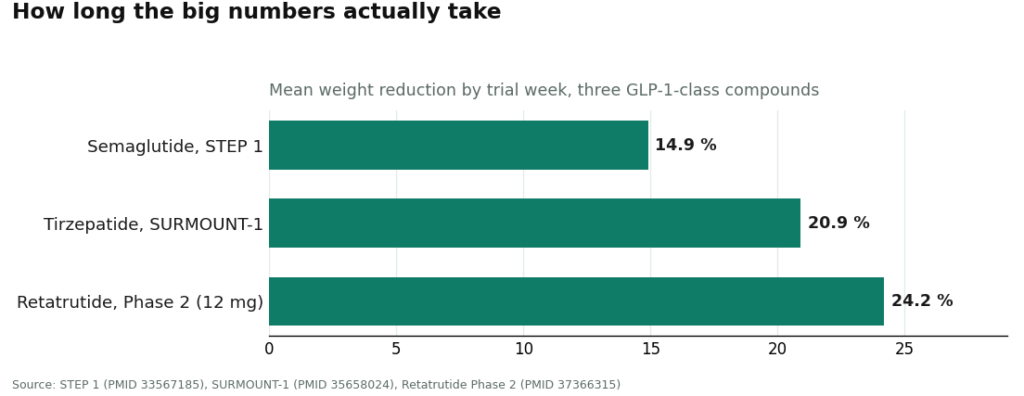
Three different molecules, three different sponsors, and the same structural fact: the impressive figure is always attached to a long runway. Nobody rushed these trials to a quick finish because a quick finish wasn’t the honest measurement. That’s not a marketing flaw, it’s what a real pharmacological effect looks like when someone actually bothered to track it properly.
There’s a second layer that supports the same point. The early stretch, before you’re at full dose, is where side effects cluster, mostly gastrointestinal, and the trials describe them as generally mild to moderate and concentrated during the dose-escalation period [2]. In other words, the part everyone hates, the slow start where you feel worse before you feel anything good, is a documented, expected phase of a titration schedule, not evidence something’s wrong. A protocol that ramps you up carefully is, again, a sign someone designed this to be measured rather than sold.
Where I have to be honest about the limits
I’d love to end there, because it’s a clean argument. But averages are averages, and I’m not going to pretend the trial numbers describe your particular week twelve. Individuals vary around those means, some faster, some slower, some well below them. So “the middle months are when it tends to feel worth it” is true for responders, and it is a real tendency, not a promise with your name on it [1][2]. If someone tells you exactly which week you personally will feel a difference, they are guessing, and so would I be.
There’s a second honest limit, and it cuts against my own argument a little. Slowness is evidence of a real measured curve only when the measuring actually happened. It is not, by itself, proof of efficacy, and a long trial with a modest result is still just a modest result. My point isn’t “slow equals good.” It’s narrower than that: slow, trial-documented, and specific beats fast, anecdotal, and vague, every time.
Which brings me to the compound that tests my thesis directly. For something like BPC-157, there is no results timeline to be slow about, because the human data barely exists. A 2025 narrative review described the published human evidence as “exceedingly sparse” and said the compound should be treated as investigational [4]. That’s not a slow curve. That’s no curve. And I’d argue that gap is more informative than any anecdote you’ll read about it working in ten days, because ten-day claims for an unmeasured compound aren’t a shortcut, they’re an absence of the thing that would let anyone verify them.
The reframe
So here’s where I land, and it’s the opposite of how most people process this information. The instinct is to treat “results take months” as bad news that needs softening, and to treat “people say it worked fast” as reassurance. I’d reverse both. A long, boring, well-documented timeline measured in weeks-to-months is the strongest available evidence you’re dealing with a real, studied pharmacological agent. A fast, undocumented timeline is usually the sound of nobody having checked.
That reframe has a practical consequence for how you should treat the access question, too. A supervised path, where a licensed clinician manages your titration through that bumpy early stretch and a licensed pharmacy dispenses a verified product, is structurally built for a slow, real timeline. It assumes months, follow-up, and adjustment, which only makes sense if the underlying effect is the kind that takes months to show up. FormBlends operates that kind of supervised access, with a licensed clinician reviewing you and a licensed compounding pharmacy dispensing if appropriate. I’m naming it as an example of what supervised, months-aware access looks like, not as a recommendation to buy anything.
Compare that to a vial arriving with no clinician and no follow-up. That model is built for a fast transaction, not a slow biological process, which is exactly backwards from what the trial data says these compounds actually are. And worth remembering: the FDA’s standing note on this is that compounded products are not FDA-approved and haven’t been evaluated by the agency for safety, effectiveness, or quality [5]. The safety net in a supervised path isn’t a stamp on the vial, it’s the clinician and pharmacy paying attention while the slow curve plays out.
Where that leaves you
Track your own numbers over months, not days, because gradual change is genuinely hard to feel in real time and easy to underrate in hindsight. Expect the documented compounds to reward patience on a schedule measured in trial-weeks, because that’s what the data literally says [1][2][3]. And treat any confident week-by-week promise about a sparsely studied compound like BPC-157 with real skepticism, since the review of the human evidence found it “exceedingly sparse” for a reason [4]. The slow curve isn’t the disappointing part of this story. It’s the part that means someone actually checked.
The usual questions
How long does it actually take to see results from peptide therapy? Months, for the compounds with real data behind them, not days. The headline figures all sit at the far end of long trials: semaglutide’s mean 14.9% reduction at 68 weeks [1], tirzepatide’s 15.0% to 20.9% at 72 weeks [2], retatrutide’s 24.2% at 48 weeks [3]. If a timeline sounds faster than that, ask what it’s actually measuring.
Why does the early stretch feel like nothing is happening? Because you’re usually still climbing the dose, and the trials titrated upward gradually rather than starting at the level that produced the big numbers. That’s also when gastrointestinal side effects tend to cluster, generally mild to moderate [2]. A slow, uneventful start is the protocol working as designed, not a sign it’s failing.
When does it actually start to feel worth the money? For responders, the middle months, once you’re near target dose and the early side effects have settled. But those trial figures are means, and people vary around them, some faster and some slower than average [1][2]. Treat “the middle is when it clicks” as a tendency, not a personal guarantee.
How long does it take BPC-157 to work? There’s no honest answer, because there’s barely any human data to build one from. A 2025 narrative review called the human evidence “exceedingly sparse” and said BPC-157 should be treated as investigational [4]. Anyone giving you a specific week is guessing, however sincerely.
Does supervision actually matter in the early weeks, or is that just upsell? It matters because the early weeks are exactly where the drop-out happens, right before the curve tends to turn. A clinician who can slow your titration when you’re struggling is the difference between quitting during the hardest stretch and getting past it. That’s a real service, and it’s missing entirely from a vial that shows up with no follow-up attached.
Should I expect to match the trial’s percentage on the trial’s schedule? Not necessarily, and I’d be suspicious of anyone who tells you that you will. The big numbers are real destinations reached gradually, but they’re averages, and individual response varies around them [1][2]. Your own tracked progress over months is a better guide than the trial mean.
References
- Wilding JPH, et al. “Once-Weekly Semaglutide in Adults with Overweight or Obesity” (STEP 1). New England Journal of Medicine, 2021. PMID 33567185. Mean weight loss 14.9% at 68 weeks, reached gradually via dose titration. https://pubmed.ncbi.nlm.nih.gov/33567185/
- Jastreboff AM, et al. “Tirzepatide Once Weekly for the Treatment of Obesity” (SURMOUNT-1). New England Journal of Medicine, 2022. PMID 35658024. Mean reductions 15.0% to 20.9% at 72 weeks; gastrointestinal side effects generally mild to moderate and most common during escalation. https://pubmed.ncbi.nlm.nih.gov/35658024/
- Jastreboff AM, et al. “Triple-Hormone-Receptor Agonist Retatrutide for Obesity, A Phase 2 Trial.” New England Journal of Medicine, 2023. PMID 37366315. Mean reduction 24.2% at the 12 mg dose, measured at 48 weeks.
- “Regeneration or Risk? A Narrative Review of BPC-157 for Musculoskeletal Healing.” Current Reviews in Musculoskeletal Medicine, 2025. PMC12446177. Human evidence “exceedingly sparse”; BPC-157 should be considered investigational, so no reliable human results timeline exists.
- U.S. Food and Drug Administration. Human Drug Compounding guidance. Compounded drugs are not FDA-approved and have not been evaluated by the FDA for safety, effectiveness, or quality.
How much does peptide therapy typically cost per month?
Most people land somewhere between $150 and $600 a month, depending on the peptide, the dose, and where they source it. A single compound like BPC-157 tends toward the low end, while a stack of growth-hormone secretagogues, say CJC-1295 with Ipamorelin, pushes toward the top. The consultation fee is usually billed separately, so get the all-in number before you agree to anything.
Does insurance cover peptide therapy?
Basically never right now. Most insurers file peptides prescribed for wellness or body-composition goals under “investigational,” which means out-of-pocket. A few narrow exceptions exist, like certain growth-hormone peptides for a diagnosed deficiency, but approvals are rare. Call and ask, sure, but plan your budget as if the answer is no.
Is peptide therapy worth the cost, or is the hype outrunning the evidence?
Depends entirely on what problem you’re pointing it at. People chasing a specific, narrow issue, slow soft-tissue recovery or bad sleep, often notice something within a few weeks and consider it money well spent. Chase general anti-aging or fat loss instead, and the evidence gets thinner and the results more scattered. My honest read: treat peptides as a modest tool, not a shortcut, because the bill adds up fast if your expectations are set for a miracle.
Why does a compounding pharmacy charge more than an online research-chemical site?
The research-chemical sites are selling product labeled “not for human use,” which is a polite way of saying no pharmaceutical-grade testing, no pharmacist checking anything, no accountability if it goes wrong. A compounding pharmacy under physician supervision, FormBlends being one example, tests for purity and potency, keeps batch records, and operates inside an actual regulatory framework. The price gap is that overhead, and once you think about what’s going into a syringe, it’s a defensible one.
Written by Marta Yang, evidence reviewer. Reporting from the sources cited above. Last reviewed May 2026.
Not professional medical advice. Speak with your healthcare provider before making a change.


